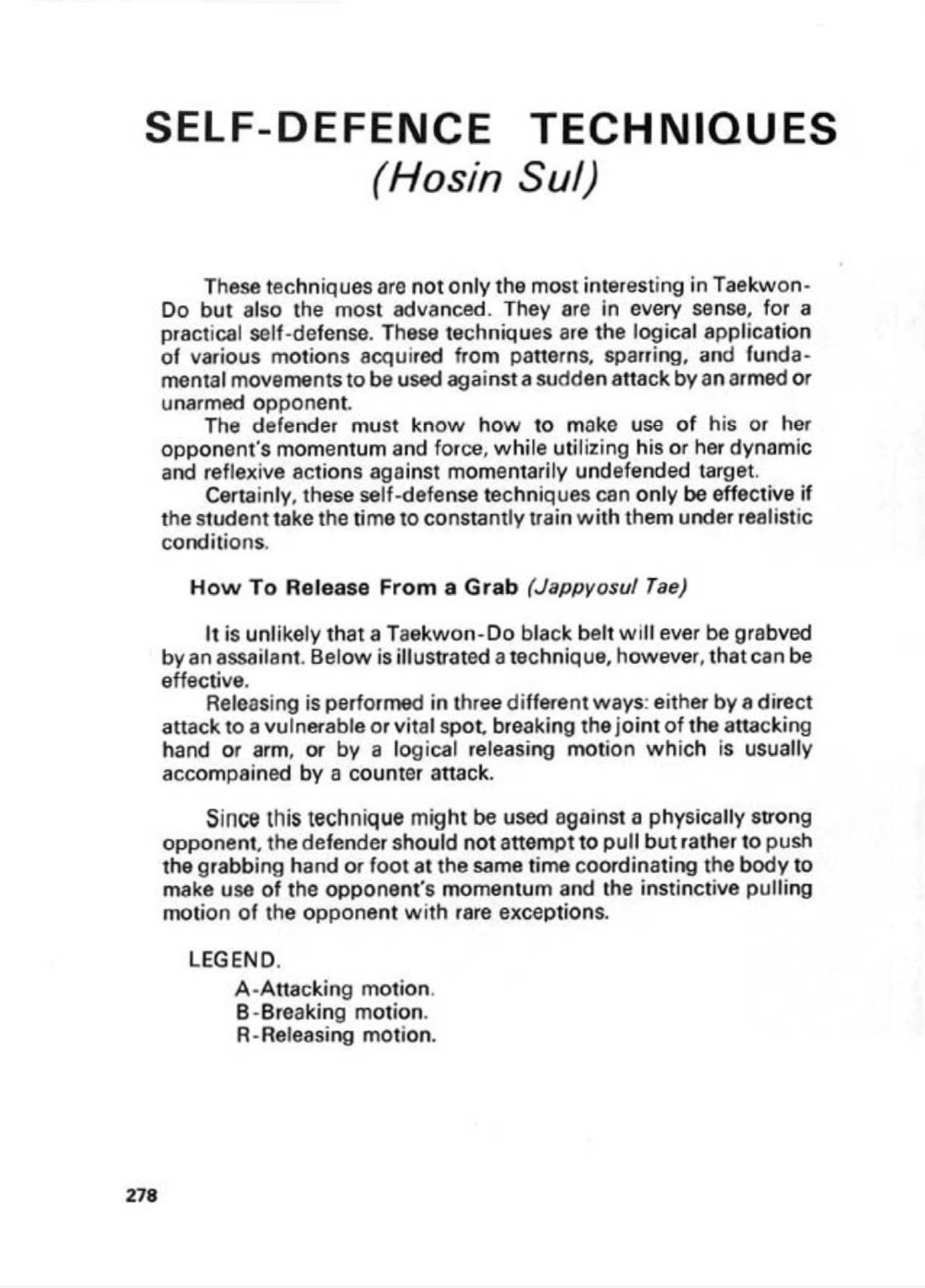
General Choi Hong Hi wrote that Ho Sin Sul consists of three main components.
General Choi Hong Hi wrote that Ho Sin Sul consists of three main components. Releasing motion, breaking motion, and attacking motion. In many ways, this simple structure gives us a deeper understanding of what self defense in ITF Taekwon-Do was originally meant to be.
The Korean term “Ho Sin Sul” is often translated as “self defense.” That translation works on a practical level, still something important disappears in the process. A more direct translation would be “techniques to protect the body.” That subtle difference matters.
Protection comes before fighting.
That mindset changes everything.
Releasing Motion
The first category is releasing motion. This is where you free yourself from grabs, holds, wrist controls, clothing grabs, bear hugs, or other forms of restraint.
This part of Ho Sin Sul is extremely important because real violence often starts with contact before it starts with striking. Someone grabs you, controls your arm, pushes you, pulls you, or tries to limit your movement. In many situations the first tactical problem is not “how do I knock this person out,” the problem is “how do I regain mobility and control?”
Releasing motion is about creating freedom.
It is about posture, angles, leverage, timing, body mechanics, balance disruption, and positioning. Many of the motions found inside the ITF patterns suddenly make far more sense when viewed through this lens. Circular movements, pulling motions, pressing motions, twisting actions, and changes of height become tools for escaping control.
This is also where ITF Taekwon-Do connects naturally with grappling arts. The body does not care about style names. Human biomechanics remain the same.
Breaking Motion
The second category is breaking motion. This includes joint locks, chokes, restraints, takedowns, and submissions designed to stop or control an opponent.
The word “breaking” can sound brutal to modern ears, still the principle itself is larger than simply damaging joints. The purpose is control. Sometimes control requires pain compliance. Sometimes it requires structural disruption. Sometimes it requires complete immobilization.
This category reveals something many people forget about traditional Taekwon-Do. General Choi did not present Taekwon-Do as purely a striking art. Ho Sin Sul clearly includes grappling, locking, off balancing, and restraint.
Many practitioners separate striking and grappling into different worlds. In reality they constantly overlap. A strike creates a reaction that opens a lock. A lock creates a reaction that opens a strike. A takedown creates an opportunity to disengage. Everything connects.
When we explore the applications inside the patterns through ITF Radix, this becomes very visible. One movement can become a release, a lock, a takedown, or a strike depending on timing, distance, and tactical context.
Attacking Motion
The third category is attacking motion. This is where striking enters the picture. Punches, elbows, knees, kicks, headbutts, and other forms of impact.
Most people immediately associate Taekwon-Do with this category because striking is the most visually obvious part of the art. Still, General Choi presented it as only one of three components.
That is important.
Modern training sometimes creates the illusion that self defense is mainly about hitting harder or faster. In reality, striking is only one tool inside a larger tactical system.
A strike can create space.
A strike can break structure.
A strike can interrupt intent.
A strike can create an escape opportunity.
The goal is not always domination. Often the goal is survival and escape.
This is why context matters so much.
The same punch can mean completely different things depending on the situation. In sparring it may score points. In self defense it may function as a distraction to release a grip. In close range it may create posture disruption for a takedown or restraint.
Protecting The Body
The more I study Ho Sin Sul, the more I believe the original concept was broader and more intelligent than many modern interpretations.
“Techniques to protect the body” creates a different mindset than simply “self defense.”
It encourages adaptability.
It encourages tactical thinking.
It encourages proportional response.
It encourages survival.
Sometimes protecting the body means escaping.
Sometimes it means controlling.
Sometimes it means striking.
Sometimes it means avoiding violence completely.
This is also why free sparring alone cannot represent the full picture of self defense. Sparring develops timing, distance, pressure management, courage, reactions, and adaptability. It is extremely important. Still Ho Sin Sul adds another layer. Grabs, clinching, restraints, off balancing, and close range control all exist in a range that normal sparring often does not fully address.
General Choi’s three categories remind us that Taekwon-Do was never meant to be one dimensional.
At its root, Ho Sin Sul is not simply about fighting.
It is about protecting the body through intelligent application of movement, strategy, and control.