
The Belt Is Not the Goal
By Grand Master Henrik Hunstad
Over a lifetime in the martial arts, I have met thousands of practitioners. Many of them shared one clear objective: earning their next rank or their next belt. That is easy to understand. Promotions provide direction, create motivation, and mark our progress along the journey.
Yet I have often found myself asking a simple question.
Have we become more concerned with the belt than with what the belt is actually meant to represent?
Historically, the belt ranking system is much younger than many people realize. The traditional martial arts had no yellow, green, blue, or red belts. In fact, many had no visible ranking system at all. Knowledge and experience were recognized through the relationship between teacher and student, often documented by written licenses. It was skill, character, and trust that earned recognition, not a piece of colored cloth tied around the waist.
When Jigoro Kano founded Kodokan Judo in the late nineteenth century, he sought to create a teaching system that would make it easier to educate larger groups of students. He introduced the dan ranking system and the black belt as markers of development. At that time, there were essentially only two belts: white and black. It was not until decades later that the colored student belts were introduced. Their purpose was never to create status or mystique, but simply to organize instruction more effectively and provide students with meaningful milestones along the way.
When this system was later adopted by the Korean martial arts, the student ranks were assigned their own colors. In Taekwondo, for example, the red belt represents the final stage before black belt. The symbolism is beautiful. It reminds us that our growing skills now demand maturity, self control, and responsibility. Even so, I believe it is important to remember that the color itself was never the point. What truly mattered was the personal growth it represented.
The belt system was never intended to be the destination.
It was meant to guide us along the path.
The same philosophy is found in the word Do, which is part of both Taekwondo and Hapkido. It is commonly translated as “the Way,” but its meaning goes much deeper. The Way is not primarily about where we are going. It is about what happens to us as we walk it. It is about how training, discipline, adversity, and experience gradually shape us into better human beings.
This understanding is also reflected in the titles we use.
In the West, we often translate Sabom as “Master” and Kwanjang as “Grandmaster.” Strictly speaking, these are not entirely accurate translations. A Sabom is first and foremost a teacher, someone who possesses both the knowledge and the ability to develop others. A Kwanjang is the leader of a school or organization, a role perhaps closer to that of a principal than the image many people associate with the title “Grandmaster.”
I believe this distinction matters.
Once again, the original meaning emphasizes responsibility far more than status.
Over the years I have also heard expressions such as “honorary ranks” or “administrative belts.” Personally, I have never been comfortable with those concepts. In my view, a rank or a belt should represent experience earned through years of training, discipline, adversity, and personal growth. It should tell a story measured in thousands of hours on the mat, of sweat, frustration, learning, perseverance, and the determination to continue when training becomes difficult.
A black belt was never intended to mark the end of the journey.
In the original understanding of Shodan or Il Dan, first degree black belt simply meant that the student had mastered the fundamentals and was finally ready to begin the real learning. Black belt was never proof that someone had finished learning. On the contrary, it was a reminder that they now carried the responsibility to continue learning.
I believe we sometimes lose sight of that.
We live in a time when titles, certifications, and visible credentials receive increasing attention. The martial arts have not been immune to this trend. It is easy to become focused on what rank we hold, what title we carry, or how quickly we can achieve the next promotion.
Yet the true value lies somewhere else entirely.
For me, the belt has never been the interesting part.
The person wearing it is.
Whether this was Jigoro Kano’s original intention, we cannot say with certainty. Even so, I have always appreciated the symbolism of the belt itself. The belt holds the uniform together, just as our values hold us together as human beings. Without character, technique means very little. Without humility, rank means very little. Without responsibility, the belt eventually becomes nothing more than a piece of colored cloth.
When I look back at the people who have made the greatest impression on me throughout my martial arts journey, it is rarely their rank that I remember first. I remember how they treated other people. I remember how they responded to adversity. I remember how they continued training after decades on the mat with the same curiosity as a beginner. I remember how they developed others without making themselves more important than the art they represented.
Those are the people who leave a lasting legacy.
After many years, I have come to another realization.
No one will remember what rank I held if that is all I leave behind. No one is remembered because they were a fourth, sixth, or eighth degree black belt.
We are remembered for how we treated people.
For how we led.
For how we taught.
For how we faced adversity.
For whether we left the people around us better than they were before they met us.
That is our legacy.
Ranks and belts are only symbols.
Our legacy is determined by the way we choose to live.
One question has stayed with me throughout the years, and perhaps it is the most important question any of us can ask, regardless of rank.
If you took off your belt today, how much of your rank would still be visible in the way you train, the way you lead, and the way you treat other people?
For me, the answer to that question lies much closer to the heart of the martial arts than the color of the belt around our waist.
Perhaps that is why, at Sangrok, we have chosen a motto that challenges instructors just as much as it challenges our students.
At Sangrok, ranks and belts are not simply awarded.
They do not represent who you are.
They represent the path you have walked to become the person you are.
Grand Master Henrik Sverre Hunstad is one of Norway’s leading representatives of Korean martial arts. Based in Oslo, he is the founder of Sangrok Norway and has played a central role in building Taekwondo, Hapkido and Kumdo under the Sangrok name in Norway.
His martial arts journey began in 1980. Over more than four decades, Hunstad has trained extensively in Korea and developed a close teacher student relationship with Grandmaster Chang Seong Dong, founder of Sangrok World Taekwondo Academy in Seoul. In 2000 he was accepted as GM Chang’s student, and in 2002 he received permission to use the Sangrok name in Norway. This later developed into a broader Norwegian Sangrok organization, rooted in Korean lineage, Jidokwan tradition and the idea of lifelong positive growth.
Beyond the dojang, Hunstad has worked with self defence, conflict management and mental preparation for private companies, public institutions, security professionals and the Norwegian Armed Forces. His teaching connects martial arts with everyday life, leadership, discipline and personal development.
Today, Grand Master Henrik S. Hunstad stands as a bridge between Korean tradition and Norwegian martial arts culture. Through Sangrok Norway, the Norwegian Hapkido community and international cooperation, he continues to promote openness, technical quality, loyalty to lineage and the principle expressed by Sangrok itself: “Evergreen growth”
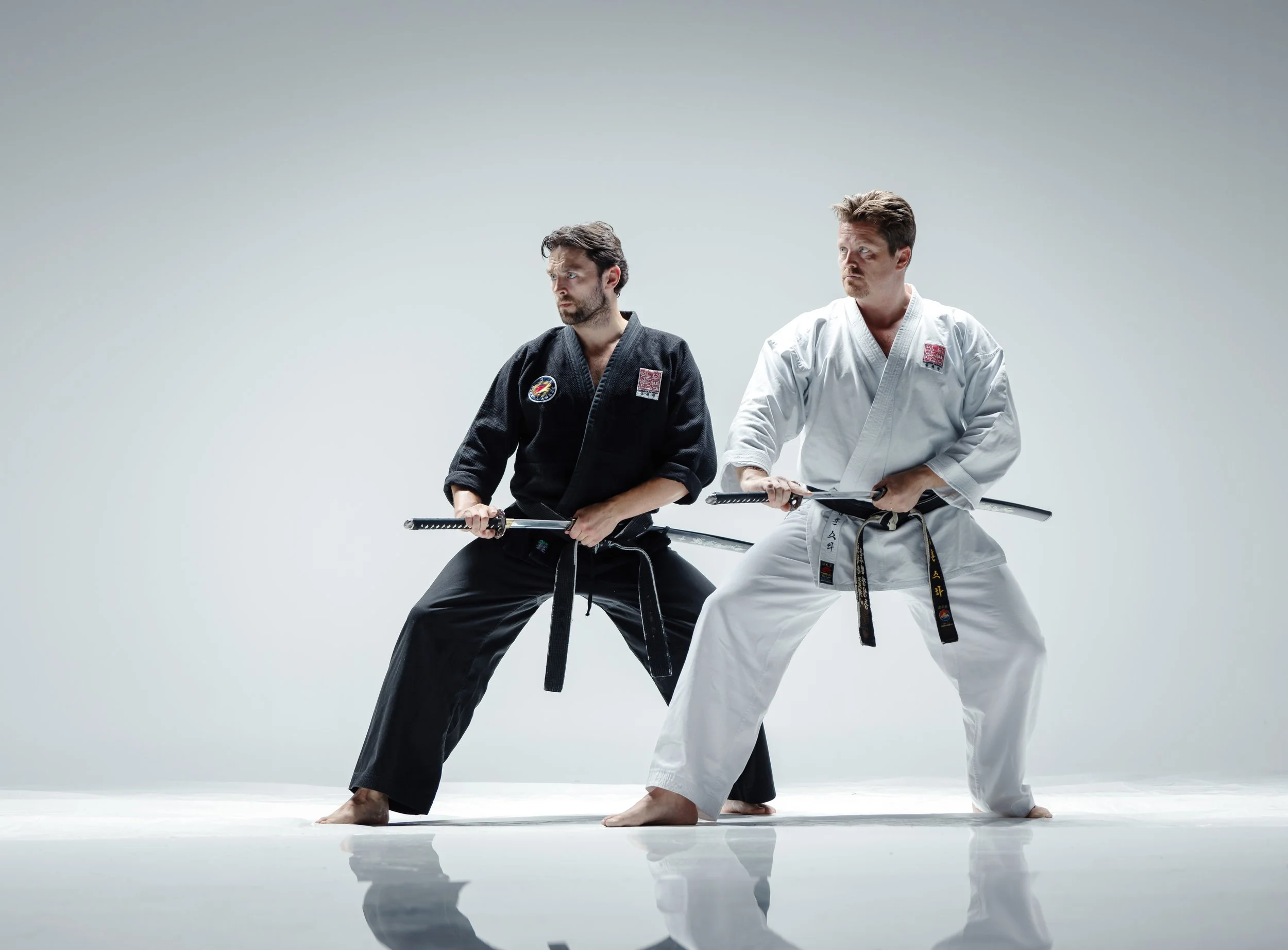
Henrik Hunstad and Roy Rolstad, from the photo shoot by the Norwegian Martial Arts Federation in 2012.