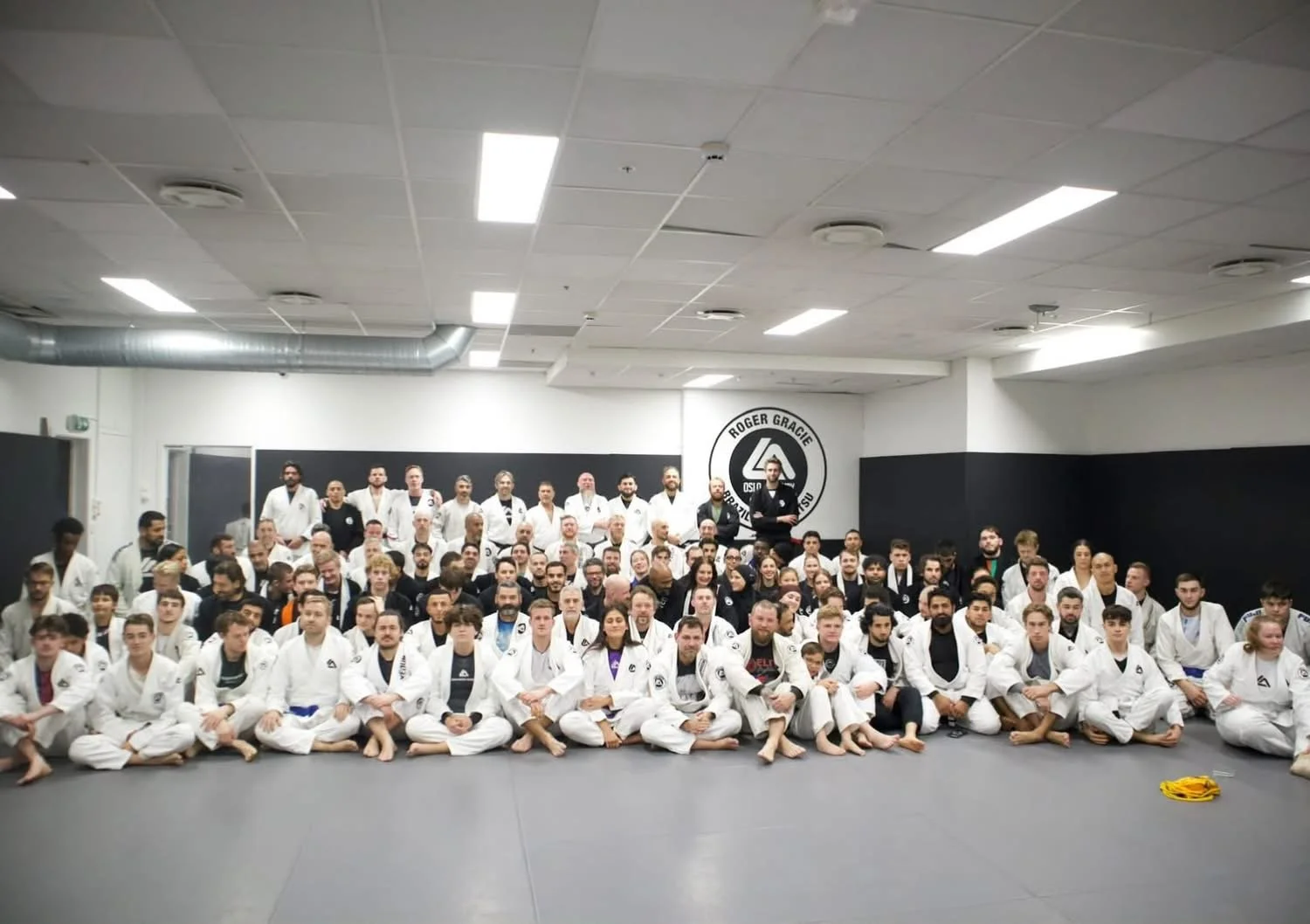
40 years of martial arts, countless detours, incredible people, and finally a Brazilian Jiu-Jitsu black belt!
I must admit, this is a big deal!
My relationship with Jiu-Jitsu goes all the way back to 1986, when I was running around the attic of the old Nidar Chocolate Factory in Trondheim, where Trondheim Ju-Jitsu Club had its dojo.
I stayed for about a year before moving on to Kung-Fu, inspired by my childhood idol, Bruce Lee. That inspiration kept me training at Trondheim Kung-Fu Club until 1993.
But I was never particularly good at sticking to just one martial art.
From 1990 to 1992, I also trained Judo at Trondheim Judokwai. One of Bruce Lee’s famous quotes had made a lasting impression on me:
“Never kick with a kicker, never wrestle with a wrestler, and never box with a boxer!”
That philosophy even sent me to Ulfan Boxing Club during a few summer holidays when the Kung-Fu and Judo clubs were closed. The boxing club was run by my uncle, Svein Erik “Spikern” Paulsen.
I wanted to learn everything!
The Tournament That Changed Everything
In 1993, Trondheim Kung-Fu Club was invited to the Lomma Cup, a Taekwon-Do tournament in southern Sweden.
We went. We saw. We got our asses kicked!
A few months before the tournament, I had contacted Trondheim Taekwon-Do Club to learn more about the competition rules. At the time, I knew practically nothing about the differences between ITF, GTF, and WTF Taekwon-Do.
Nevertheless, they welcomed me and let me spar with them in preparation for Sweden.
It didn’t help much.
I was knocked out of action by a back kick straight to the stomach that completely knocked the wind out of me.
And then things got worse.
A Turkish referee, who had possibly the worst breath I have ever experienced, rushed over to help me breathe.
There I was, desperately gasping for air while simultaneously trying to push this well meaning referee and his terrible breath away from my face.
It’s a wonder I didn’t quit martial arts right there!
But looking back, I really feel that this was where everything started.
When I returned to Trondheim, I signed up at the Taekwon-Do club.
Under Instructor Per Andresen, I became part of a small group of adults that included Robert Skagseth, who has been one of my best friends ever since.
I continued training Kung-Fu alongside Taekwon-Do for the rest of 1993. However, my Kung-Fu Sifu wasn’t particularly enthusiastic about me training Taekwon-Do.
So in 1994, I returned to Ju-Jitsu instead.
Two important lessons stayed with me from my Kung-Fu years.
First, always look beyond the obvious movements in the forms. Explore the hidden applications and understand that one movement can have several purposes. This curiosity has followed me since childhood and remains central to how I approach martial arts today.
Second, you have to spar to bring your martial art to life.
These two ideas would eventually become important parts of what we do with ITF Radix.
Two Martial Arts, One Bicycle
Those years training Taekwon-Do and Ju-Jitsu in Trondheim were wonderful.
I remember one particular day when my orange belt grading in Ju-Jitsu was scheduled for exactly the same day as my blue belt grading in Taekwon-Do.
I asked to be in the first group on the mats at Ju-Jitsu, finished my grading, grabbed my bicycle, and pedaled like a madman across Trondheim.
I arrived just in time to join the last group at the Taekwon-Do grading.
Two gradings, two martial arts, one bicycle.
Perfectly normal behavior!
In 1995, I moved to a small village outside Ålesund.
Since our Taekwon-Do federation had no clubs in the region, I decided to start one myself.
I also joined Ålesund Ju-Jitsu Club, which belonged to the same organization as the club I had trained with in Trondheim.
Once again, I could continue exploring both arts.
I was working as a teacher at the local school while running my own Taekwon-Do club. For the first two years, I was the only instructor and didn’t take any direct payment for teaching.
Instead, the club covered much of my travel expenses for seminars, camps, and tournaments.
The members considered it an investment in the quality of their training.
And I certainly wasn’t going to argue with that!
I traveled everywhere I could.
My First Encounter With Brazilian Jiu-Jitsu
In 1998, I saw an advertisement for a seminar in Ålesund:
BJJ / Vale Tudo.
I was addicted to seminars back then. I still am!
Naturally, I gathered some of the guys and signed us up.
The seminar was conducted by two Swedish instructors, Richard and Yari.
I remember Yari having a bit of a bad boy attitude, while Richard was calmer and more approachable.
This was only five years after Royce Gracie had introduced Brazilian Jiu-Jitsu to the world through the first UFC.
My background in Judo helped me understand much of what the Swedish instructors were teaching, but there were some important differences.
The biggest revelation was flow rolling.
I had done plenty of Ne Waza in Judo, but never quite like this.
Another fascinating concept was the emphasis on taking your opponent’s back rather than giving up your own back.
That weekend, one of Norway’s early Brazilian Jiu-Jitsu clubs was founded.
I was hooked.
Later that year, I moved to Oslo.
My students took over the responsibility for the Taekwon-Do club I had started, and in 2026 we celebrated its 30th anniversary!
That is something I’m incredibly proud of.
Oslo, Shootfighting, and Some Interesting Characters
When I arrived in Oslo in 1998, I contacted the Swedish BJJ instructors again and trained with them for a while in the basement of Kampen Gym.
The training was outstanding, and the guys were great, especially Richard.
But there was a problem.
The environment around the gym included some rather colorful characters from Oslo’s criminal underworld.
Since I was considering a career in law enforcement, I eventually decided that this wasn’t the ideal place for me to spend my evenings.
So I returned to traditional Ju-Jitsu and joined Oslo Ju-Jitsu Club, which belonged to the same organization I had trained with in Trondheim and Ålesund.
I also joined the local Taekwon-Do club.
Around this time, I met Thomas Hytten, who was establishing Shootfighting in Norway.
There were essentially two camps within this emerging martial arts scene in Oslo.
One was Shooters Shootfighting, with Thomas Hytten as a central figure.
The other was the Scandinavian Brazilian Jiu-Jitsu Alliance, SBJJA, where Richard and Yari were among the leading personalities.
I had friends on both sides.
At the time, I was also serving on the board of the Norwegian Martial Arts Federation. Thomas was working hard to get Shootfighting organized within the established sports system, but he faced considerable resistance.
Thomas had his mentor in August Wallén, a leading figure in Swedish and European Shootfighting.
I had the privilege of attending seven instructor courses under August in Gothenburg and Oslo.
August was exceptionally organized and systematic in his approach to martial arts.
Those instructor courses remain some of the highlights of my entire martial arts journey.
Back to Trondheim
In 2000, I moved back to Trondheim.
I had just captured the love of my life, Camilla. ❤️
I was also getting tired of the conflicts within the local Taekwon-Do environment in Oslo.
At Oslo Ju-Jitsu Club, the curriculum seemed to change constantly. Just when you thought you had learned what was required for your next grading, everything was turned upside down.
And the situation between SBJJA and Shooters was sometimes uncomfortable, particularly when you had friends in both organizations.
Back in Trondheim, I began studying to become a teacher at Levanger while helping run the local Taekwon-Do club, which was largely operated by university students.
At the same time, I co-founded Trondheim Shootfighting Club with my good friends Einar Næss and Eirik Wammer.
It was a fantastic project.
For those unfamiliar with Shootfighting, the sport combined kickboxing and wrestling while standing. Once a fighter touched the canvas with anything other than the soles of their feet, striking was no longer permitted.
From that point, it was grappling only.
You could win by knockout while standing, submission on the ground, or points at the end of the match.
In simple terms, MMA without ground and pound.
The term MMA wasn’t even commonly established at that point.
We had two great years in Trondheim, but eventually I faced a dilemma.
Master Per Andresen was strongly opposed to full contact competition as a matter of principle.
His reasoning was simple:
“If the aim of a sport is to give your opponent the medical diagnosis of concussion, then it isn’t a sport.”
I understand that argument, and I agree with the underlying concern.
Per made it clear that if I wanted to continue as an instructor at Trondheim Taekwon-Do Club, I couldn’t compete in full contact martial arts.
I could train as much as I wanted, but he didn’t want his instructors participating in full contact competition.
I respected his decision.
So I continued teaching and competing in Taekwon-Do while training, grappling, and sparring with the Shootfighting guys.
And I was perfectly happy with that arrangement.
Filipino Martial Arts and Another Detour
There is another important part of this story that deserves mentioning.
My involvement with Filipino Martial Arts.
My first real encounter with stick fighting was at a Jeet Kune Do seminar in Molde in 1994, conducted by Sifu Larry Hartsell, a first generation student of Bruce Lee.
We were introduced to stick fighting, grappling, foot locks, and several other fascinating concepts.
After moving to the Ålesund region, I continued attending these seminars every year.
During the 1994 Winter Olympics in Lillehammer, I was also involved with a group of martial artists providing Viking camp entertainment for tourists.
There I met Johan Skålberg and Åge Thoen.
This was my introduction to Kali Sikaran.
Over the following years, we traveled to seminars and camps all over the place, and I gradually incorporated knife and stick training into our self defense practice in both Taekwon-Do and Ju-Jitsu.
When Camilla and I moved to Oslo in 2003, I co-founded Oslo Kali Sikaran Club together with Åge and Frode Thoen, Cato Fjeldet, and Trond Løvlie.
Yet another martial art to explore!
Oslo Again, and the Search for Grappling
In 2003, we moved back to Oslo so I could complete my education as a correctional officer.
I left teacher education and entered the Correctional Service Academy.
Camilla and I also started Oslo East Taekwon-Do Club, which we still run today with tremendous success and a fantastic community of students and instructors.
I continued training with Thomas Hytten and the Shooters community.
Meanwhile, the BJJ scene had developed considerably.
The group I had trained with earlier had moved to Kringsjå and attracted a much larger membership.
In 2003, they organized a seminar with Royce Gracie.
For me, that was another milestone.
I really wanted to return to regular grappling.
I tried Oslo Ju-Jitsu Club again, but something was still missing.
Then I began exploring the Korean version of Ju-Jitsu: Hapkido.
After trying a couple of places, I eventually found Sangrok around 2005.
There I met Henrik Hunstad, who became a close friend, training partner, and travel companion.
Hapkido is an extremely versatile martial art, with striking, throws, wrist locks, joint manipulation, and a wide range of weapons.
But I still missed something.
Sparring.
I had plenty of stand up sparring through Taekwon-Do, but I wanted to roll.
From 2003 to 2017, I was practically a nomad when it came to Brazilian Jiu-Jitsu.
I spent about a year at Frontline Academy, where I sometimes spent 30 minutes to an hour just looking for parking.
Eventually, I became more of a supporting member than an active student. I simply couldn’t motivate myself to drive around Oslo looking for a parking spot before every training session.
I also trained for a while at BJJ Holmlia, in a small corridor covered with mats.
Great people and good training, but I still hadn’t found exactly what I was looking for.
And during those years, I developed a pretty effective system for managing my ego.
If I wanted to boost my confidence, I could visit Oslo Ju-Jitsu Club and submit almost everyone in the room.
If I wanted to get my ego thoroughly checked, I could visit Frontline Academy and get submitted by practically everyone above blue belt.
A healthy balance!
Judo With the Kids
When our children were born and eventually became old enough for children’s Judo, we started spending one day every week at Norsk Judo og Jiu-Jitsu Club at Haugerud in Oslo.
Our daughter Alba trained there for four and a half years before starting Taekwon-Do at six.
Our son Melvin stayed for ten years, starting with children’s Judo at two years old and continuing until he was twelve.
I joined the adult classes while watching the kids grow up on the mats.
Today, both are competing in Taekwon-Do at the highest level, and I couldn’t be prouder of them.
More importantly, they have become fantastic role models for the younger students in our club.
Watching that development has been one of the greatest rewards of my martial arts life.
2017: Finally Finding My BJJ Home
Then, in 2017, I discovered a treasure.
Roger Gracie Oslo, at Frontline Muay Thai, Aleksander Kiellands plass with Paulo as head coach!
BJJ lunch training!
Finally!
Here was a place where I could train with resisting opponents every day at 11:00.
I had been working at Oslo Prison since 2003, and anyone who works shifts knows how difficult it can be to maintain a consistent training schedule.
Some days you’re off. Some days you work early. Other days you work evenings or nights.
Finding regular BJJ classes in the middle of the day was absolutely perfect.
And the people!
I remember the way I felt when Elyes included me from the second I entered the door at FMT!
And when we opened the door at Valhall Arena! A world class Martial Arts center!
I met an incredible group of martial artists who shared the same enthusiasm for training, learning, and rolling under the coaching of Paulo Peixito, one of the most technical coaches I’ve ever trained with. He also has the most easy going personality you can find.
Taekwon-Do classes in the evenings.
Brazilian Jiu-Jitsu at lunchtime.
Hapkido on some evenings.
Seminars and camps whenever possible.
And life was good!
For almost ten years, this has been my routine.
Training, teaching, learning, experimenting, and occasionally getting my ass kicked by people half my age.
Exactly how I like it!
Two years ago Paulo moved on and left the team, and Elyes took over as main coach.
Consistency in presence and clear structure was his way! And a very clear language, with ability to explain from different points of view using metaphors in the most creative ways only Elyes can! Humor and the same easygoing mentality as his master the last decade.
Then suddenly!
November 5, 2026: The Black Belt!
And now, after all these years, I have been honored with my black belt in Brazilian Jiu-Jitsu!
Holy shit!
From that attic in the old Nidar Chocolate Factory in 1986 to the mats at Roger Gracie Oslo in 2026.
Forty years of exploring martial arts.
Countless seminars, camps, clubs, instructors, training partners, friendships, and experiences.
And somehow, I ended up here.
I have received black belts and instructor grades in several martial arts over the years, but this one feels special.
Perhaps because BJJ has constantly reminded me how much there is left to learn.
Perhaps because of the incredible people I’ve had the privilege of training with.
Or perhaps because I still feel like a white belt every time I step onto the mats.
And I genuinely love that feeling!
Thank You! ❤️
First of all, I want to thank my wonderful wife, Camilla.
For putting up with my endless martial arts adventures, seminars, camps, traveling, and all those hours on the mats.
And, most importantly, for washing my Gi all these years! ❤️
I dedicate this red bar at this black belt to you! ❤️
And of course, a massive thank you to Elyes Abid.
The job you do coaching and developing everyone is simply incredible.
Your dedication, your personality, and the environment you create make a tremendous difference.
You are genuinely one of my favorite personalities in all of martial arts, my friend!
Thank you!
Thank you to Criss and Tommy for your investment and risking in this place! You are doing us a great service by doing what you have done here at FMT!
Thank you to my close colleague and friend Lasse who also got his blackbelt promotion today, it’s a special honor to stand here with you today!
And to everyone I’ve trained with over the years, from Trondheim to Ålesund, Oslo, Sweden, and everywhere else:
Thank you for the lessons, the friendship, the bruises, the submissions, and the laughs.
There is one particularly important thing Brazilian Jiu-Jitsu has taught me.
It has taught me what it feels like to be a white belt.
And I still have that feeling when I roll with all of you at breakfast, lunch, or evening classes.
There is always someone better.
Always something new to discover.
Always another problem to solve.
And that is exactly why I love it.
I’m looking forward to continuing to roll with all of you.
The journey continues!
Much love! ❤️
⬛️⬛️⬛️🟥🟥⬛️