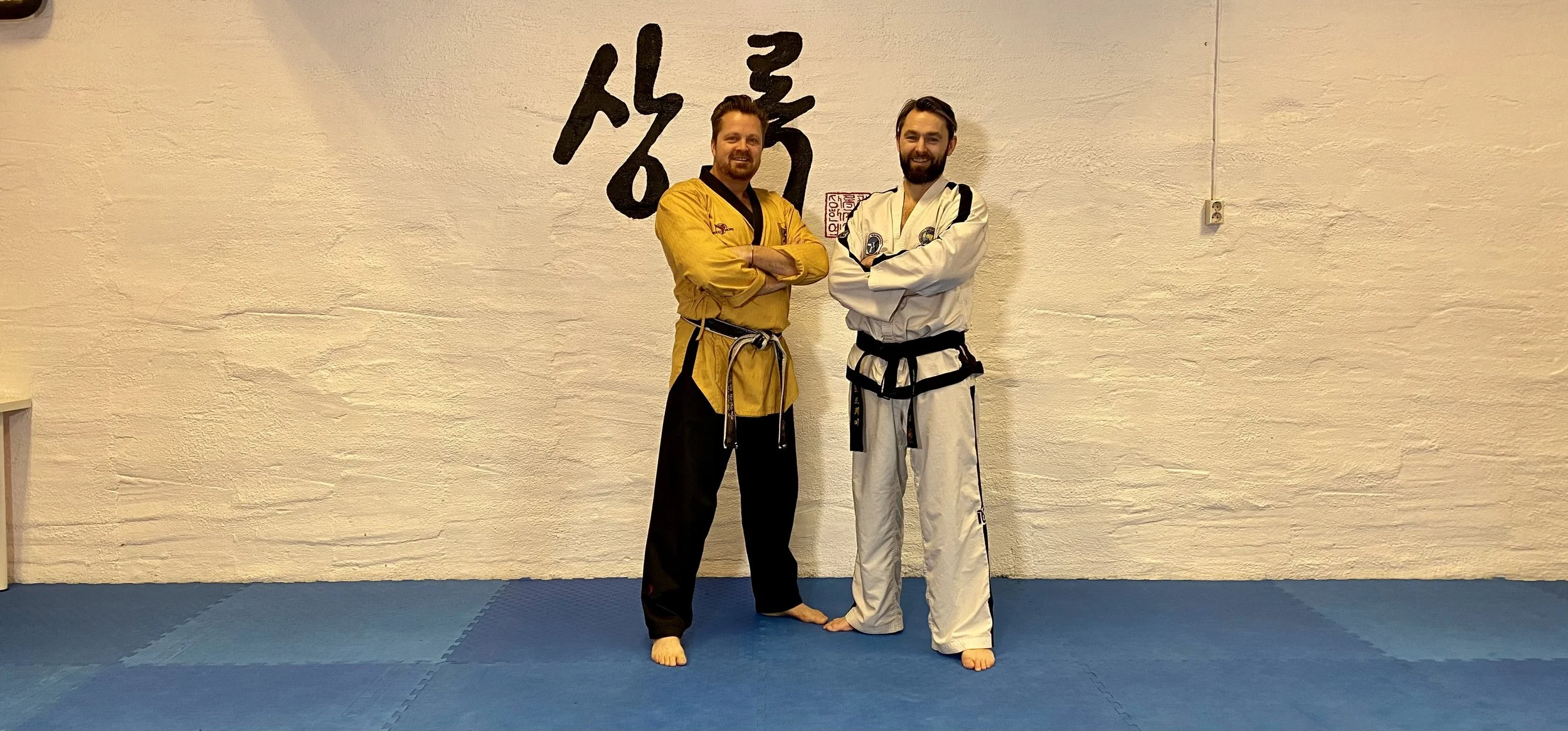
“I Don’t Have Time to Train” By Grand Master Henrik Hunstad Foreword by Roy Rolstad
I have known Grand Master Henrik Hunstad for many years, both as a martial artist and as someone who has spent a great deal of time thinking about what martial arts training is actually supposed to do for us.
Henrik is the founder and head of Sangrok, and his martial arts background reaches far beyond technique, rank, and physical training. One of the concepts he has developed and frequently returns to is Shimshin, a Korean term built around shim, mind or heart, and shin, body.
Henrik uses Shimshin to describe something that is easily forgotten in modern life: the body and mind are not two separate systems competing for our time. They are parts of the same human being.
That idea connects closely with how we think about martial arts within the ITF Radix project. Training is obviously about developing physical skills, but it is also about learning, adapting, dealing with pressure, solving problems, building resilience, and understanding ourselves. Physical and mental development constantly influence each other.
This article addresses an excuse most instructors have heard countless times:
“I don’t have time to train.”
Henrik challenges that statement from a different angle. Perhaps the periods when life becomes busiest are exactly when maintaining some form of physical training becomes most important.
— Roy Rolstad
Co founder, ITF Radix
I Don’t Have Time to Train
“I don’t have time to train. I have so much schoolwork.”
That is a statement I have a hard time understanding.
Of course, I understand that school, university, work, and other responsibilities can fill our days. Life is busy for many people, and all of us go through periods when there is simply more to do. What I have less understanding for is when training consistently becomes the first thing removed from the schedule simply because the calendar is full.
The same applies to adults who say:
“I can’t train. I have way too much going on at work.”
When I hear that, I sometimes wonder whether the real problem is a lack of time, or how that time is organized.
I will say it even more clearly:
If you have a lot of stress in your daily life, the answer is often not to train less. You may actually need to train more.
That does not necessarily mean training harder or longer. Consistency is what matters most.
A recent Norwegian study gives us good reason to think about this. In a national prospective study published in PLOS ONE, Michael Grasdalsmoen, Erlingur Johannsson, Mari Hysing, and Børge Sivertsen examined the relationship between physical activity and mental health among Norwegian college and university students. The study used data from 53,362 students participating in the SHoT study, with a portion of the students followed up one year later.
The researchers found that students who rarely or never exercised had a higher risk of later developing common mental health disorders such as depression and generalized anxiety compared with students who exercised regularly. The study does not prove that a lack of exercise automatically causes mental health problems, but it does show a clear relationship over time between physical activity and mental health.
For me, the important question is what we do when life gets busy.
When school becomes more demanding, exams are approaching, or working days become longer, I believe training should still be maintained. What can change is the format, duration, or intensity.
A shorter session is still training.
A lighter activity is still training.
A simpler form of exercise is still training.
The important thing is to maintain continuity because we function best when physical and mental activity work together.
There is always something else that can be done. You can read another chapter. You can spend another hour polishing an assignment. You can stay at work a little longer.
If training always has to wait until everything else is finished, it may never find a place in your life.
Training does not have to be another burden added to an already stressful day. It can be one of the things that helps you handle that stressful day better. Sometimes we need to revise our routines instead of removing the things that help keep us balanced.
The Mind and Body Are One
We often talk about the mind and body as though they are two separate parts of us.
They are not.
The mind and body form a holistic whole. They influence each other constantly, and both require attention, care, and development.
Intellectual stimulation nourishes the mind. Learning, reflection, reading, and challenges help us develop mentally.
Physical activity nourishes the body. It strengthens us, regulates us, and makes us better equipped to handle stress and pressure.
When we give both the mind and body what they need, we create a stronger foundation for harmony between them.
This is what I call Shimshin: a holistic balance in which a person develops the mind while also taking care of the body through which that mind experiences life.
This is why I believe it is a mistake to place school and training in opposition to each other, as though one must always be sacrificed for the other.
Intellectual work and physical activity complement each other.
We need both if we want to function well over time.
Parents have a particular responsibility here. When parents ask their children to give up training because school is more important, they may unintentionally send the wrong message.
School is important. Children and teenagers also need physical activity, healthy routines, and places where they can experience achievement, community, and personal development.
Children should learn that physical activity is part of functioning well, especially when life becomes demanding. They should learn that taking care of the body does not conflict with developing the mind.
Over many years, I have watched students dedicate themselves seriously to their sport. Many of them also perform well academically, later in their professional lives, and in life in general.
That does not mean sport automatically creates success, nor does it mean everyone who succeeds has participated in sports. Still, I see a clear pattern.
Those who show up even when motivation disappears learn responsibility.
Those who practice the same technique hundreds of times develop patience.
Those who lose, fail, or fall short of their goals learn how to deal with adversity.
Those who belong to a team or training environment learn cooperation and respect.
These qualities have value far beyond sports. They matter in school, in professional life, and in our relationships with other people.
I am not saying everyone should train hard every day, or that every child should participate in competitive sports.
I am saying that regular physical activity should have a natural place in life.
Parents should help their children find that place rather than being the first ones to take it away.
The same applies to adults.
If your job consumes so much of your time and energy that there is no longer room for physical activity, sleep, family, or other important parts of life, perhaps you need to look at your daily life as a whole.
What are you spending your time on?
What can be reduced or organized differently?
What is truly important?
What can wait?
We cannot always control the amount of schoolwork, our responsibilities at work, or the challenges life puts in front of us. Still, we often have more influence over how we organize our daily lives than we like to admit.
Sometimes the issue is not that we do not have enough time.
Sometimes we simply have not prioritized that time.
And sometimes we have forgotten what training is actually supposed to do for us.
Training is about more than becoming stronger, faster, or looking better.
It is about taking care of the body and mind that must carry us through life.
It is also about building the capacity to stand under pressure.
It is about Shimshin.
Bodymind. Body and spirit in balance.
It means giving both the mind and body the attention and care they need so they can function together in greater harmony.
So perhaps we should stop asking:
“Do I have time to train?”
Instead, ask:
“How do I make room for training, especially now that I am stressed?”
Because when life becomes so demanding that you feel you no longer have the energy to train, that may be exactly when you need training the most.
— Grand Master Henrik Hunstad